
That opacity isn’t malicious — it mostly reflects the fact that publishing decisions are genuinely subjective and context-dependent. A manuscript that’s wrong for one list is right for another. What an editor can acquire depends on what they’ve acquired recently, what they’re trying to build, and a dozen other factors you can’t know from outside.
But there’s a lot you can know, and most writers don’t do as thorough a job of the research as they could.
Start with books, not publishers
The most useful way to find the right publisher isn’t to browse publisher catalogues — it’s to look at the books that most resemble yours and find out who published them.
If you’ve written a literary novel with a strong sense of place and a quiet narrative register, there are publishers who consistently acquire that kind of book. Their editors have a track record with it. Their marketing teams know how to reach that readership. They’re a fundamentally better fit for your manuscript than a publisher whose list is dominated by high-concept commercial fiction, however prestigious they might be.
Go to a bookshop. Look at the books shelved near where yours would sit. Turn them over and read the publisher information. Read the acknowledgements — authors often thank their editors by name, which tells you who to address a submission to. This takes time and it’s unglamorous, but it produces genuinely useful information.
What agents are actually for
If you’re targeting traditional publishers, especially larger ones, you’ll almost certainly need an agent. That’s not a gatekeeping exercise — it’s a structural feature of how the industry works. Large publishers receive far more submissions than they can read, and they rely on agents to do a first pass. An agented submission arrives with an implicit endorsement: someone who knows the market well enough to make a living from it thought this manuscript was worth representing.
Agents also negotiate contracts, which is the other reason to have one. Publishing contracts are long and complicated and contain clauses that matter a great deal to your interests as an author. Having someone in your corner who understands them is worth the commission.
Finding the right agent follows the same logic as finding the right publisher. Look at the acknowledgements of books like yours. Look at the agency websites of agents who represent authors you admire. Read their submission guidelines carefully — agents often describe what they’re looking for in specific terms, and a submission that ignores those signals suggests the author hasn’t done the research.
What a rejection actually means
Most rejections don’t tell you what you need to know, which is whether the manuscript needs more work or whether it was simply the wrong fit for that particular agent or publisher.
“Not right for my list at this time” is not a verdict on the quality of your book. It genuinely means what it says: this isn’t what that agent or publisher is currently looking for, for reasons that may have nothing to do with your manuscript.
A pattern of rejections is more informative than any single rejection. If you’ve sent to twenty agents who represent books like yours and heard nothing back, that’s worth taking seriously. If you’ve had some requests for full manuscripts that didn’t result in offers, the problem may be in the manuscript’s second half, or in the first fifty pages, or somewhere more specific. If you’ve had personal responses that mention similar issues, those are worth heeding.
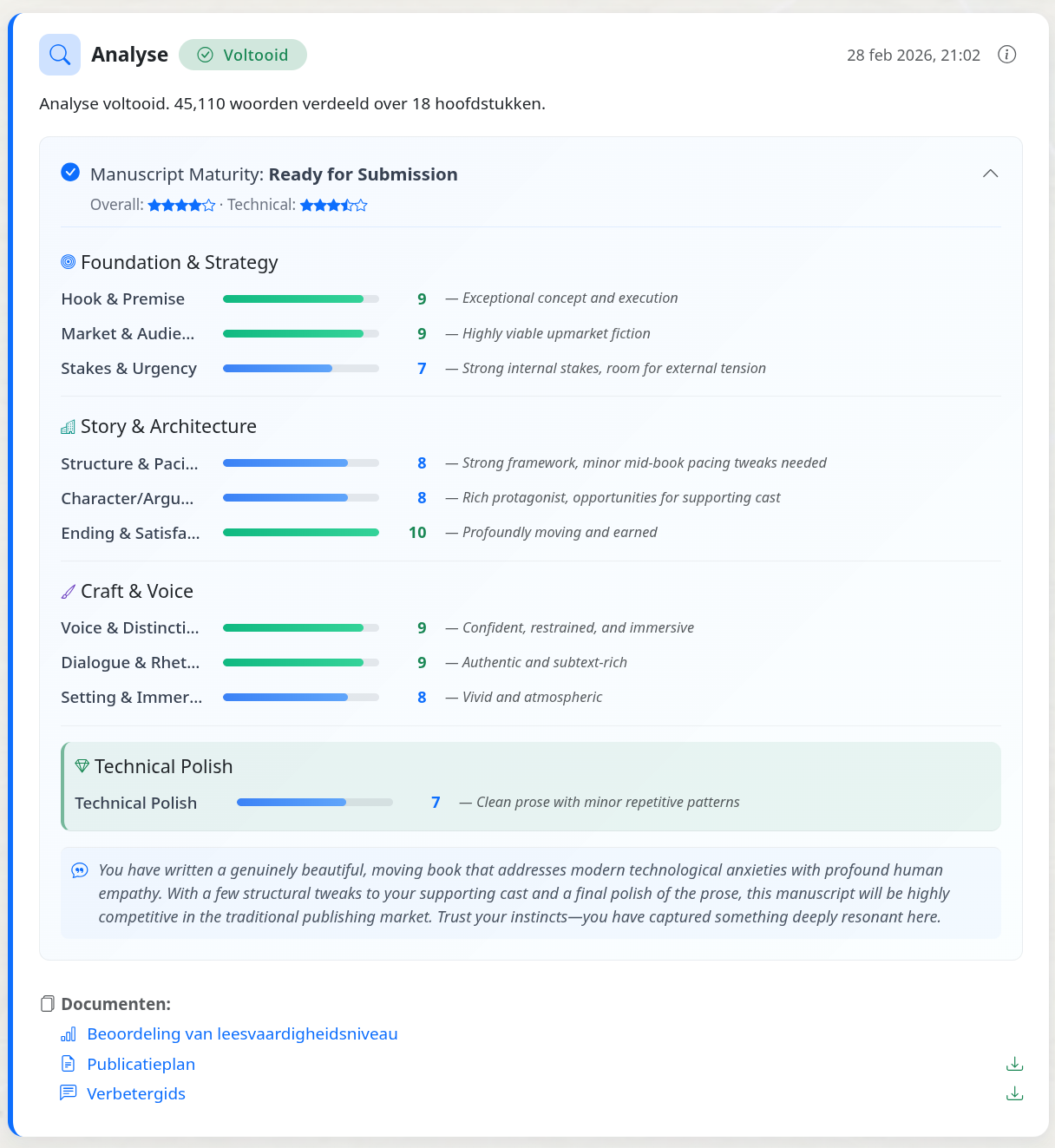
An analysis report can tell you where your manuscript stands relative to submission standards — useful to review before you start sending.
The preparation that makes a difference
Before you submit anywhere, make sure you can answer three questions clearly:
What is this book? Not a plot summary — a sense of what kind of reading experience it offers, what it’s about in the way that matters, and why someone would want to read it. If you can’t answer this, neither can the agent or publisher you’re pitching to.
Who is it for? Not “everyone” — that’s not an answer. A specific readership, described in terms of what they read and what they’re looking for, is useful to both you and the people you’re submitting to.
Where does it sit? What books does it sit alongside? What comparable titles can you mention that give an agent or publisher a quick sense of your manuscript’s territory? Comparisons that are too broad (“fans of literary fiction”) aren’t helpful. Specific, recent comparisons (“readers who enjoyed [Author X]’s last novel might also find this…”) are.
The answers to those questions shape your query letter, your synopsis, and the pitch you make in person if you get that far. Getting them right before you start submitting saves you the experience of sending to people who were never the right fit.
EditBook’s analysis module produces an author feedback report and a publication plan that can help you understand your manuscript’s positioning before you begin the submission process.