
New feature
New: an assistant alongside your manuscript
Annotate differences in a translation, rename a character throughout the book or work through a change of setting. The assistant can find the passages and propose edits.
Thinking about manuscripts, AI, publishing workflows, and what it means to make a good book.
Annotate differences in a translation, rename a character throughout the book or work through a change of setting. The assistant can find the passages and propose edits.

Some editorial questions only make sense at manuscript scale: whether the ending earns its setup, where continuity breaks, which translated sentences still feel foreign, or what changed since the previous draft. The chat finds the relevant material itself before it answers.
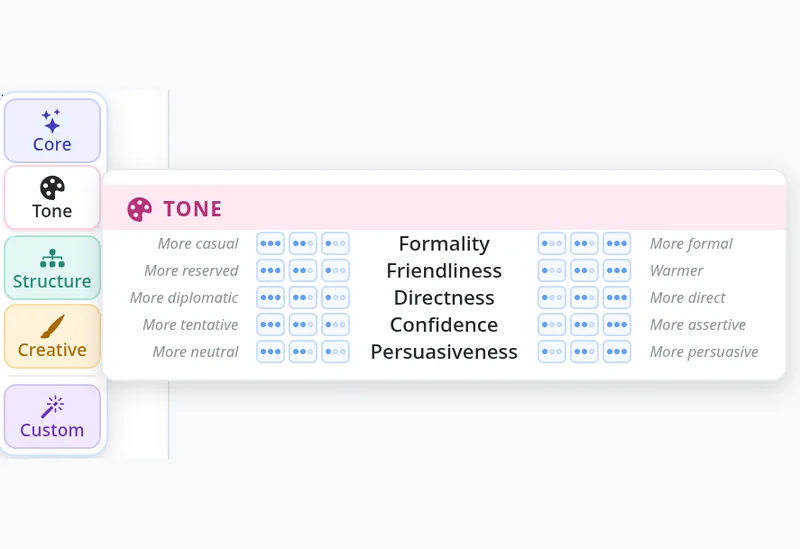
The usual problem: you copy a paragraph from Word into ChatGPT, paste the result back, and Word shows one large change: 'paragraph replaced.' The new floating AI-menu creates sentence-level changes directly in the editor.
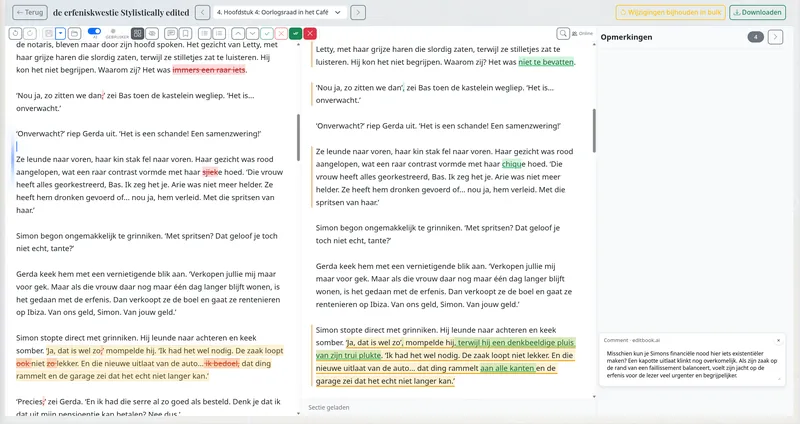
We've shipped a side-by-side track-changes editor that keeps AI edits and human edits in distinct layers — original on the left, edited version with revisions and comments on the right, scroll-locked and click-synced.
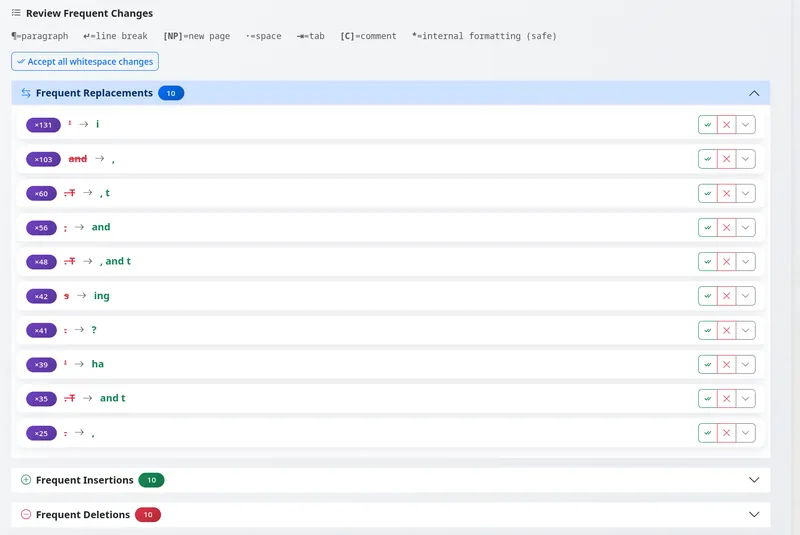
When the AI fixes the same comma-splice pattern 47 times across a manuscript, you should not have to click Accept 47 times. The new bulk-review interface groups recurring changes by pattern so you can handle them in one go — and drill in when you want to.

Most writers, at some point, have a manuscript that resists being finished. Not because the idea is wrong — you still believe in it — but because something in the execution isn't working, and you can't quite put your finger on what.

Most small publishers have a short list of titles they've always thought had foreign rights potential but never found the time to act on. The bottleneck is rarely enthusiasm — it's the cost and effort of producing a translation sample.

The submission process is opaque in ways that feel almost deliberate. Publishers don't publish their criteria. Agents give vague guidance. Rejections rarely explain anything useful. Here's what actually helps.

If you've ever passed on a manuscript on a Friday afternoon and wondered, a few months later, whether you read it as carefully as it deserved — you'll recognise the problem this is trying to solve.

A lot of books start with a very specific reader in mind — someone who shares your background, your interest, your experience. That specificity is often what makes them good. But it can also make you uncertain about whether the book has an audience beyond the obvious one.

Finishing a first draft is a real achievement — most people who start a book never get there. But the moment after you type the last sentence is also one of the most disorienting in the writing process. What exactly are you supposed to do with it now?

Most AI writing tools hand you a black box: text goes in, different text comes out. If you've ever spent twenty minutes comparing two documents trying to reconstruct what actually changed, you'll know why that's not a workflow — it's just extra work.
Please make sure you have read our Terms and Conditions regarding acceptable content and AI-provider restrictions.