
Most editors I know have a system for their slush pile. Skim the first page, check the synopsis, judge the covering letter. It works up to a point. But when the pile is large enough, the system starts making decisions that have more to do with your attention than with the quality of the submissions. Good manuscripts arrive on the wrong day. Opening pages are slow, but the story finds its footing by chapter three. The query letter is awkward, but the prose is assured.
I don’t think there’s a way to eliminate that problem entirely — reading takes time, and time is the one thing an editorial department is always short of. But I do think there’s a way to make the first pass more consistent, so that fewer manuscripts fall through the gaps.
What you’re actually trying to do in triage
The goal of a first-pass read isn’t to decide whether you love a book. It’s to decide whether a book is worth the time it would take to find out. Those are different questions, and conflating them is part of what makes submission reading so exhausting.
A structural analysis can handle the first question more reliably than a tired reader on a Friday afternoon. Is the narrative arc coherent? Does the pacing hold across chapters, or does it stall badly in the middle? Is the narrator’s voice consistent, or does the register shift in ways that suggest the author hasn’t found their footing yet? Is the book legible enough as a market proposition that you could describe it to an acquisition board?
None of that tells you whether you’ll love the book. But it tells you whether the manuscript is ready for a full read — and that’s a useful filter to have before you commit the time.

An analysis report covers publishability, readability, structure, and market fit — giving you an overview before you open the manuscript.
The part that still needs you
The one thing analysis doesn’t help with is the opening. Not structurally — you can measure sentence complexity and readability — but in terms of whether you want to keep going. Whether the world of the book is one you want to spend time in. That’s a feeling, and it’s yours. No analysis replaces it.
What analysis does is give you more confidence about the manuscripts you’re setting aside. When a structural report shows fragmented pacing, an inconsistent narrative voice, and no clear market position, you can pass with more assurance that you’re not missing something. And when a report shows a well-constructed manuscript with a clear voice and a legible premise — even if the opening pages haven’t grabbed you yet — you know it’s worth going further before you decide.
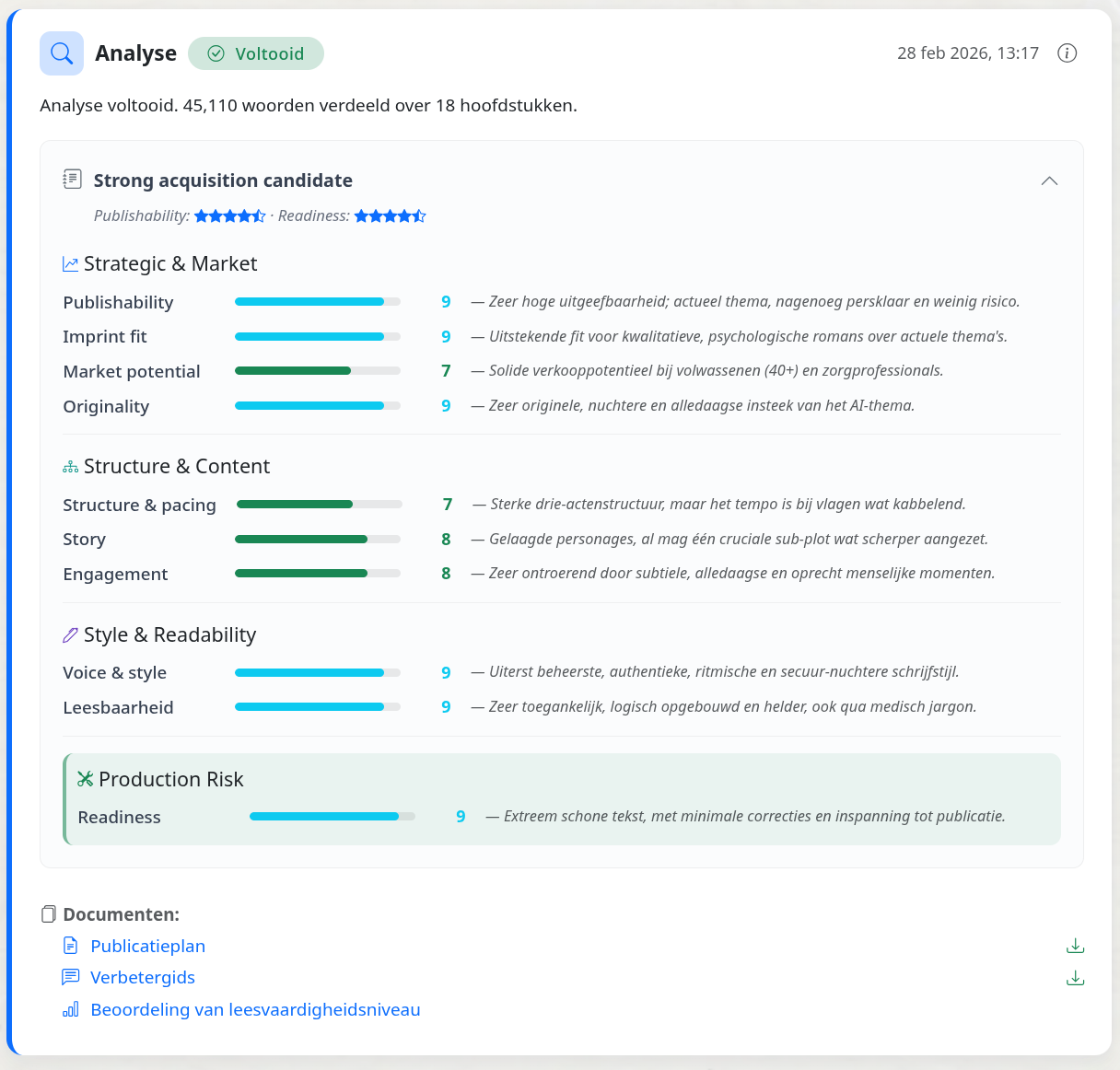
A real analysis report from EditBook for a Dutch non-fiction manuscript, showing scoring across structure, style, market fit, and production risk.
The manuscripts that get lost in a rushed pile
There’s a particular category of submission that worries me most when I think about high-volume reading: the manuscript from a writer who doesn’t know the conventions of the covering letter, whose first pages commit the usual first-novel sins, but whose story — if you got twenty pages in — would have your full attention.
Those manuscripts need a consistent first pass. Not a favourable one, but a consistent one — the same analytical attention you’d give to something that arrived with a strong recommendation. Systematic analysis is at least a step in that direction. It can’t guarantee that every strong manuscript gets found, but it removes some of the variability that comes from reading under pressure.
If that sounds like a modest claim, it is. But in a submission process that runs on human attention, reducing variability matters more than it might seem.
EditBook’s analysis module scores submissions across publishability, structure, style, and market fit — producing a shareable report that you can attach to your internal notes or send directly to the author.