
The instinct for many writers is to send it out immediately, or to show it to someone, or to start revising the first page before the last one has dried. All of those instincts are understandable and most of them are worth resisting, at least for a while.
The gap between “done” and “ready”
A first draft is a draft. That sounds obvious, but it’s worth sitting with for a moment. What you have is the raw material of a book — the story, the characters, the structure in some form. What you don’t yet have is a manuscript that’s ready for someone else to read critically, let alone for a publisher to consider.
The distance between those two things varies enormously from writer to writer and book to book. Some first drafts are close — structurally sound, well-paced, with a clear voice that holds throughout. Others have a strong central idea but a structure that doesn’t quite support it yet, or a first act that takes too long to find its focus, or an ending that was written in a rush.
Before you can revise usefully, it helps to know which of those things is true of your manuscript. And that’s genuinely hard to assess from inside it.
Why you can’t see your own book clearly
After months of writing the same story, you read your manuscript differently from how a stranger reads it. You know what you meant by the ambiguous passage in chapter four. You remember deciding to delay the reveal until chapter twelve and so you read toward it with that knowledge in mind. You’ve forgotten that the secondary character who becomes important in the second half is barely introduced in the first.
None of this is a failure of craft. It’s just what happens when you’ve been too close to something for too long. The book you can see in your head and the book that’s actually on the page have diverged slightly, and you need some distance — or some outside perspective — to see the gap.
That outside perspective can come from a trusted reader, a writing group, or a structural editor. It can also come from a manuscript analysis, which looks at your book the way a new reader would: without knowing what you intended, reading only what’s there.
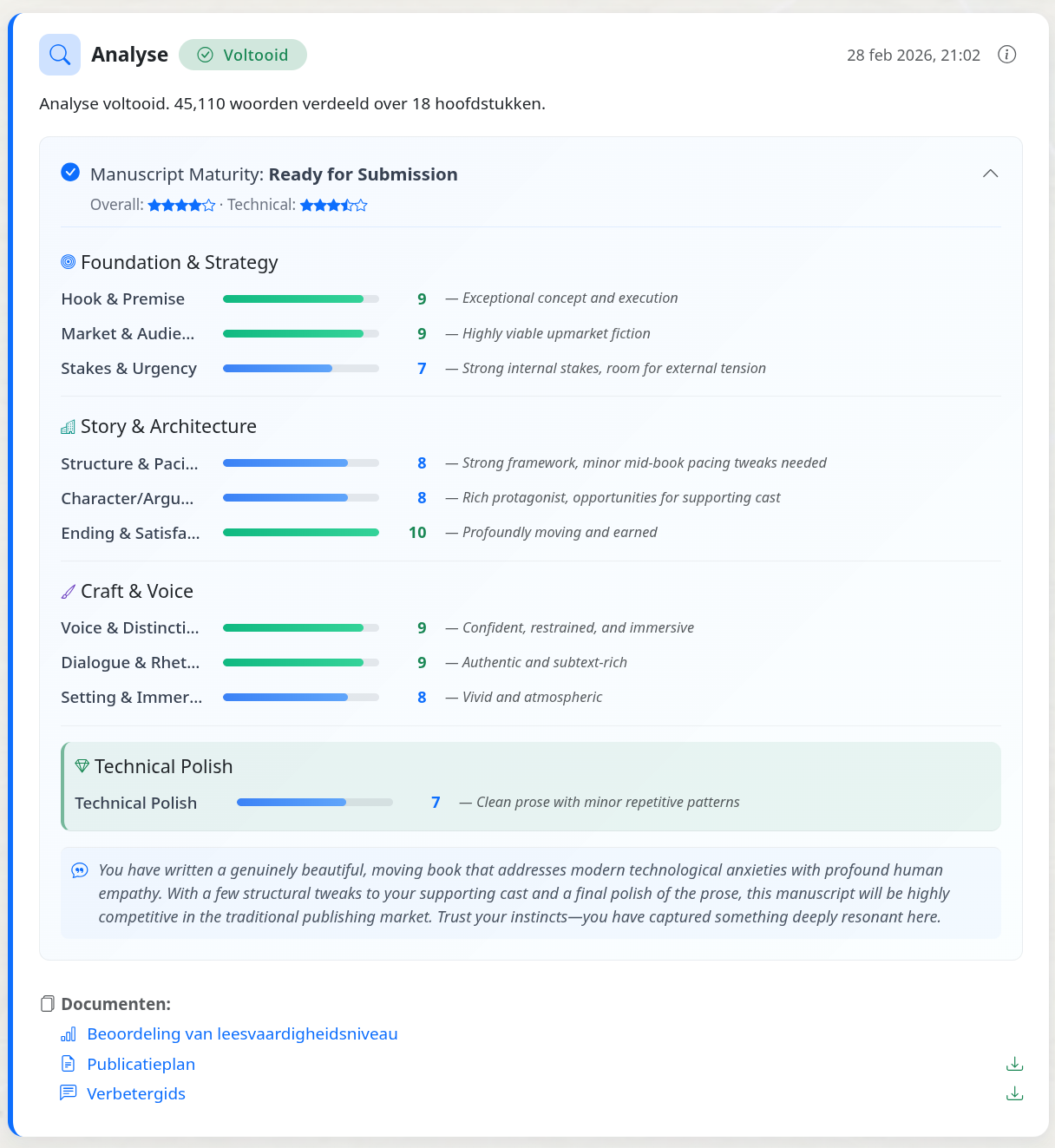
An analysis report gives you a structured view of where your manuscript is strong and where it needs work — before you start revising or submitting.
What to do with the feedback
Whatever form of outside perspective you seek, the question you’re trying to answer is the same: where is the gap between what I intended and what’s on the page?
Sometimes the answer is encouraging — the structure is solid, the voice is consistent, and the main thing needed is a line edit. Sometimes it’s more substantial — a pacing problem in the middle section, a character arc that doesn’t land, an opening that doesn’t yet earn the reader’s attention.
Either way, knowing is better than not knowing. Revising without a clear picture of what needs fixing is slow and often counterproductive. You tighten sentences in chapters that may not survive the next structural pass. You spend weeks on dialogue when the real issue is that the plot loses momentum in act two.
The goal of this stage isn’t to produce a perfect manuscript. It’s to produce a clear picture of what your manuscript actually is — so that the revision you do next is the revision it actually needs.
A word on timing
If you’ve just finished a first draft, the most useful thing you can do right now is probably nothing. Put it away for a few weeks. Let the story stop living so vividly in your immediate memory. When you come back to it, you’ll read it more as a reader and less as the person who wrote every sentence.
Then get the outside perspective. Then revise.
That sequence isn’t glamorous, but it’s the one that tends to produce the manuscripts that are actually ready when they reach a reader — or a publisher.
EditBook’s analysis module gives you a structured assessment of your manuscript covering structure, voice, pacing, and market positioning — along with an author feedback report you can use to guide your revision.