Manuscript Analysis
How a first-read report turns uncertainty into revision priorities
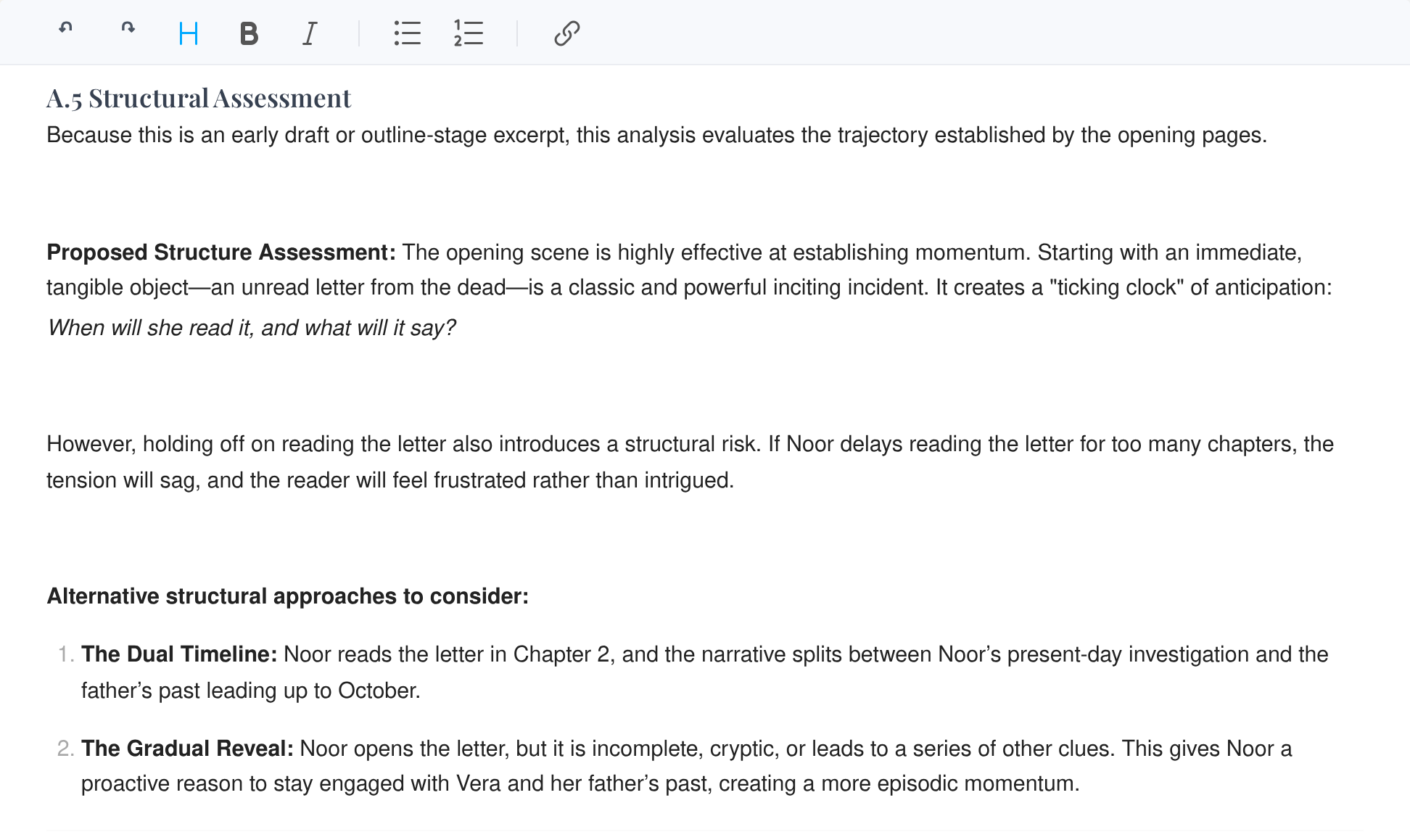
An analysis of the scene with Noor and the letter
The report examines what the reader can infer from the scene, how the tension develops and which questions remain open. Use the observations to return to the relevant passages and decide what needs work.
In short
An editorial report to help you locate questions, examine the evidence and choose the next revision priorities.
- One, two or three independent AI perspectives, combined into one report with agreements and differences of opinion.
- Optional market research with comparable books, positioning and source links.
- Ten-axis editorial review (structure, voice, market fit, audience match, register, and more) with concrete revision steps.
- Personalised to your imprint when a Publisher Overview is configured — otherwise reviewed against general editorial criteria.
- A manuscript synopsis, chapter-by-chapter summaries, an insightful analysis of characters and narrative structure, a draft back-cover blurb, and a publishability assessment.
- Exportable PDF — shareable with authors, acquisition teams, or your editorial board.
Before a first read, you want to know where to pay attention. The analysis brings chapter summaries, observations about structure and voice, and revision priorities together in one report. Check the observations against the manuscript and use them to prepare your own reading or a discussion with the author.
Your manuscript is scanned automatically on upload
The process starts the moment you upload a .docx file. Before you do anything else, EditBook.ai runs a quick scan in the background. This extracts the basics: the working title, the chapter structure, a list of characters (or core concepts, for non-fiction), word counts per chapter, and the language of the manuscript.
None of this requires you to press a button — it happens automatically. By the time you open the project page, the chapter list is already there.
The quick scan also determines whether the manuscript is fiction or non-fiction. That distinction forms the basis for the rest of the analysis, which adapts its structure accordingly. In fiction, the focus is on character development and how scenes connect; in non-fiction, on the structure of the argument and the quality of its supporting evidence.
The report adapts to your imprint and audience
Before you run the analysis, there's one thing worth knowing: EditBook.ai uses your publisher profile to personalise the report. If you've set up a Publisher Overview in your organisation settings -- describing your imprint, your catalogue, your target audience, and your editorial identity -- the analysis will evaluate the manuscript against that context.
This means the report doesn't just say whether a manuscript is "good" in the abstract. It tells you whether it fits your list, whether the audience matches your readers, and whether the editorial effort is realistic for your team. The Publisher Overview acts as a personalised lens for measures like Publisher Identity Fit and Market Fit.
If no Publisher Overview is configured, the analysis still works -- it simply evaluates the manuscript on general editorial criteria rather than publisher-specific ones.
Choose one, two or three perspectives
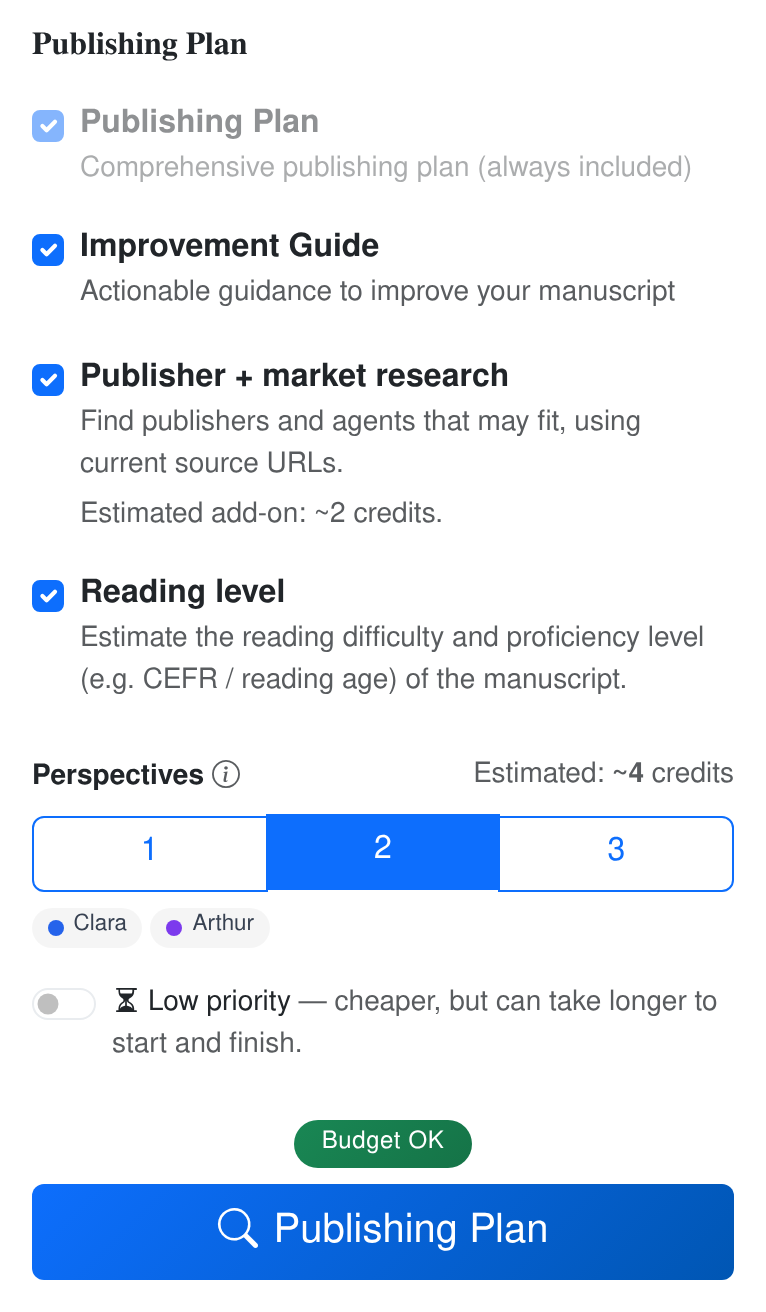
A second reader may notice something the first reader missed, or judge the same passage differently. With EditBook, you choose one, two or three AI perspectives on the full manuscript. Each perspective is an independent reading by a different AI model.
With several perspectives, you receive one combined report. It brings shared observations together and keeps differences of opinion visible, with the AI editor named. The scores also show the range of assessments. You can see where the readings agree and which passages call for your own judgment.
Add market research
Where does this manuscript sit among books already being published? Optional market research looks for comparable titles using current web sources. A separate report explains the similarities, differences and possible positioning, with links to the sources.
The research takes genre, readership and your publisher profile into account. Validated findings are also used in the market-related sections of the manuscript analysis, helping you assess the book’s place in your list.
Choose the additional reports
The main analysis report is always included. You can also add author feedback: a separate document with concrete revision suggestions, written for the author. Review it before sharing it with the writer.
Before starting, review the credit estimate for your manuscript. More perspectives add reading and comparison work, so they cost more credits. Optional market research and author feedback are each charged once, regardless of the number of perspectives.
After you start, EditBook analyses the full manuscript, prepares the report and scores, and generates the additional reports you selected. Reading-level analysis can also be included. The processing time depends on the manuscript and your settings.
Ten editorial signals, a full report, and concrete next steps
I. Ten signals show strengths and improvement areas at a glance
When the analysis finishes, you see a summary card with the overall verdict, star ratings, and ten scores displayed as progress bars with one-line explanations. This is designed as a quick overview — you can see at a glance where the manuscript is strong and where it needs attention.
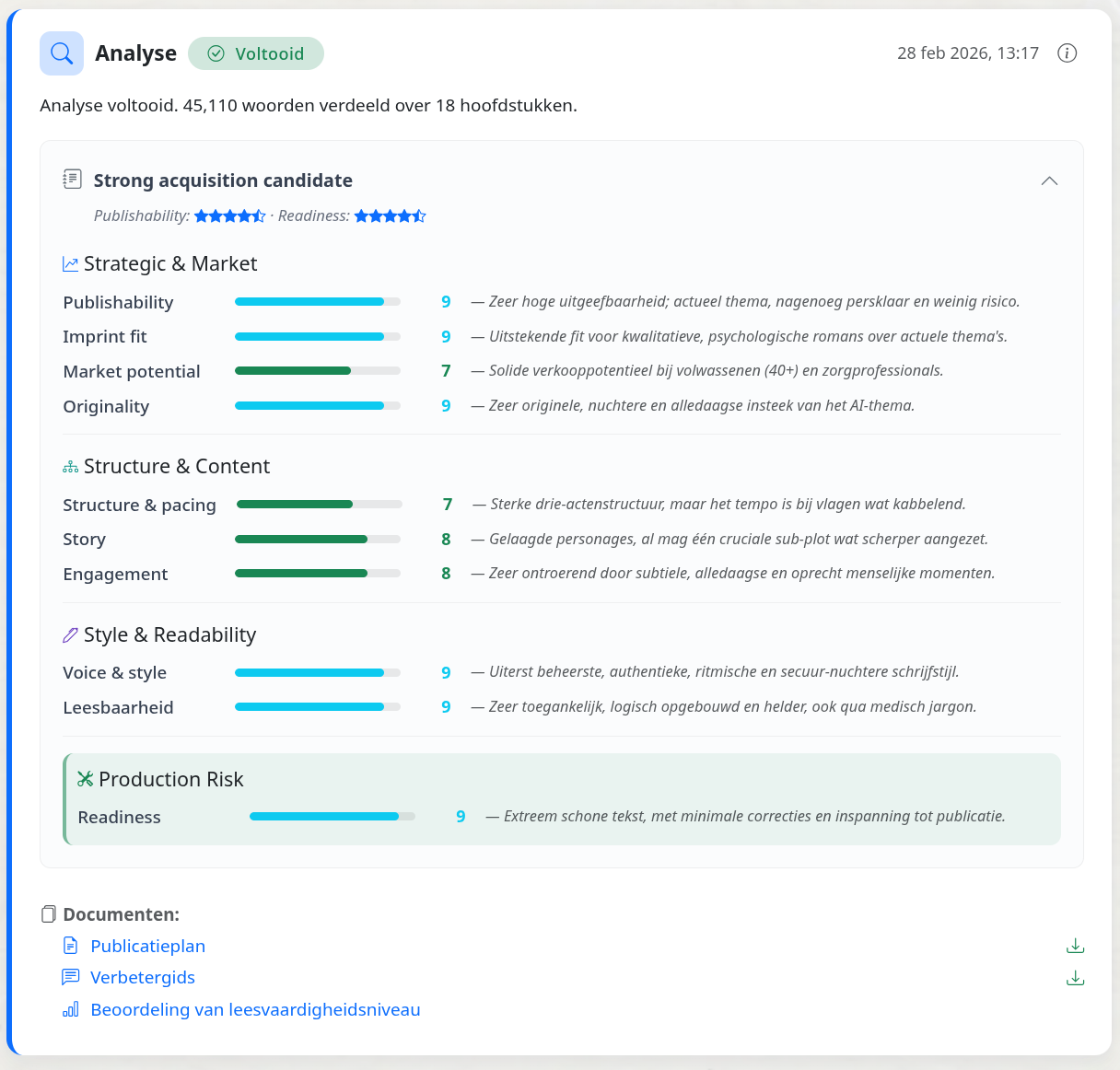
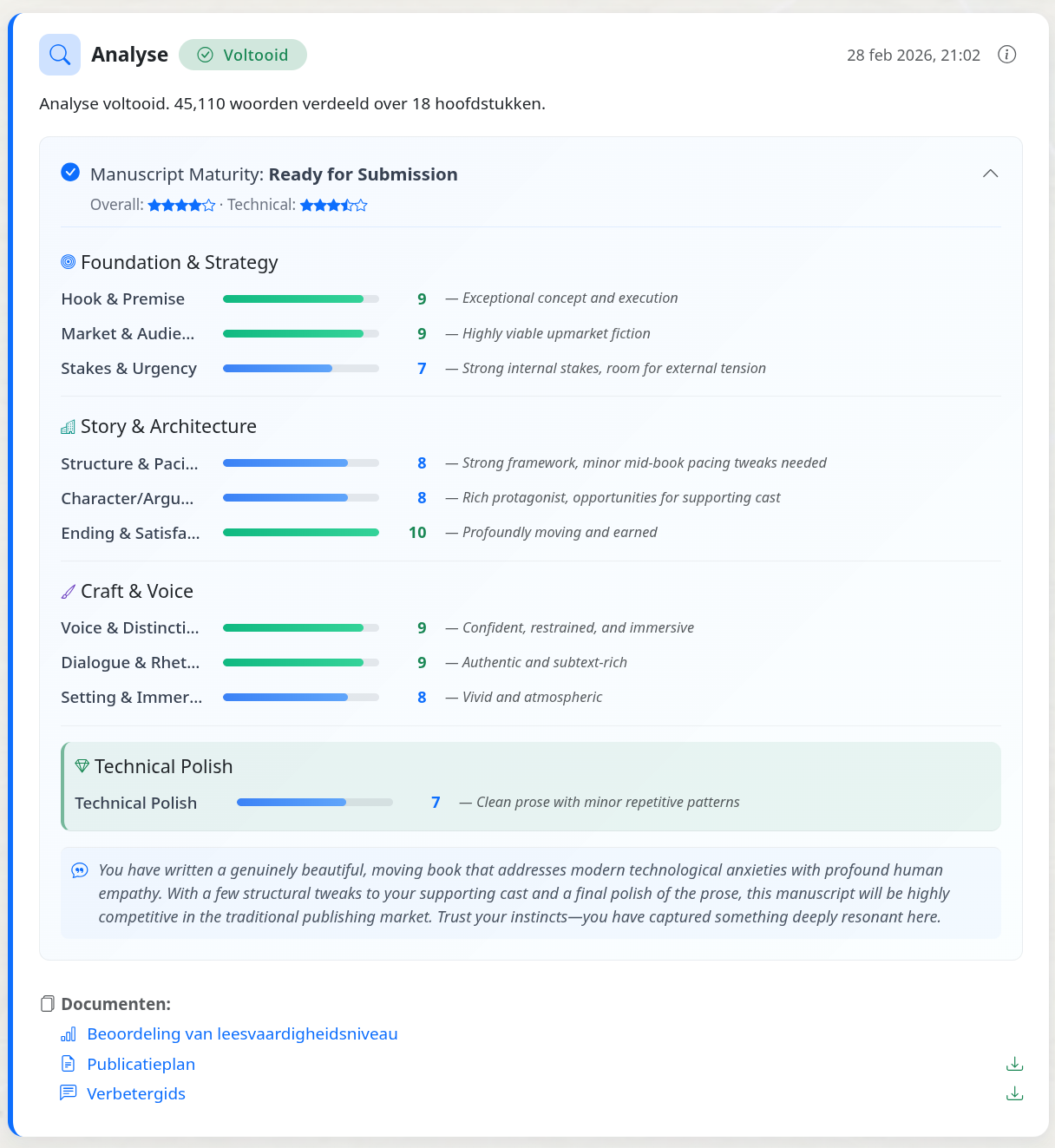
Click on any score to expand it. Each score includes a short explanation, a longer rationale with evidence from the text, and a concrete improvement action you can take. This makes the scores directly actionable — you don't just see a number, you see what to do about it.
The signals are calibrated against explicit editorial anchors:
| Range | Meaning |
|---|---|
| 0–2 | Needs a substantial rethink |
| 3–4 | Needs significant development |
| 5–6 | Mixed / conditionally viable |
| 7–8 | Strong / solidly publishable |
| 9–10 | Exceptional |
The ten metrics are: strategic publishability, publisher identity fit, market fit and sales potential, originality and USP, structure and pacing, character or argument strength, impact and engagement, writing style and voice, readability and clarity, and technical correctness.
The review distinguishes surface corrections from questions that need editorial judgment, such as a missing plot connection, an unclear argument or a shift in voice. Those observations help you estimate and prioritise the revision work; they do not put it beyond repair.
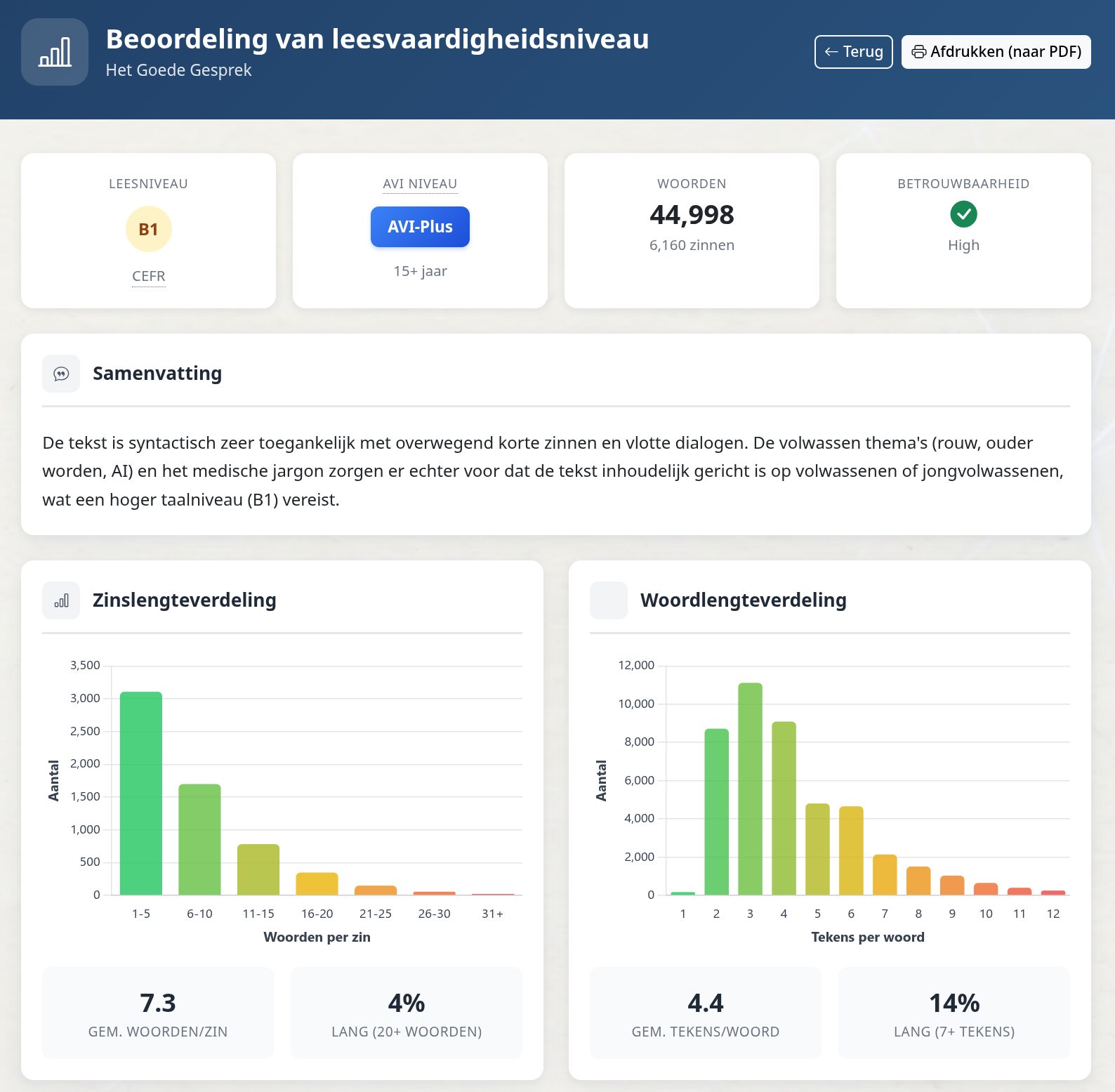
II. Readability: statistical metrics plus AI reading-level assessment
The readability report combines statistical metrics with an AI-assessed reading level. It shows sentence and word length distributions, vocabulary profile, Flesch and other readability scores, and arrives at a CEFR level (A1 through C2) with an estimated reading age.
This matters for books targeting younger audiences or specific reading levels — a book can score "easy" on a formula like Flesch because it uses short sentences, while the themes and vocabulary actually demand an older, more experienced reader. The model is instructed to correct for this.
III. A 4,000-word editorial report in six sections
The core of the analysis is a structured editorial report of approximately 4,000 words, organized into six major sections:
- Summary — the most important points from the entire report.
- A. Summary — plot synopsis (or thesis summary for non-fiction), theme, genre and audience, character overview (or concept overview), and chapter-by-chapter summaries.
- B. Content Analysis — nine subsections covering target audience and market fit, publisher identity and portfolio fit (including a "gatekeeper analysis" with a brand alignment checklist), thematic consistency and originality, emotional or practical impact, narrative structure and arc, scene connectivity and functional flow, logical consistency, character analysis (or argument strength), and a minimum of three concrete improvement proposals. Each section states clearly where the manuscript excels and what would make it stronger.
- C. Writing Style Analysis — ten subsections covering contemporaneity, language level and readability, narrative perspective and tense consistency (with at least three concrete examples), voice and tone, show-don't-tell and imagery, dialogue quality (or anecdote quality for non-fiction), rhythm and stylistic devices, characteristic passages that show what is working and what can be improved, length and pacing metrics, and technical correction investment with error density estimates and copyediting hour calculations.
- D. Publication Strategy — illustration recommendations, a title analysis with at least ten alternative suggestions, cover design proposals, a back-cover blurb of 120–140 words, and promotion ideas.
- E. Publishing Advice — an overall verdict, an analysis matrix (manuscript status, sales potential, editorial effort, author capacity, publisher fit), must-fix action items, nice-to-haves, and estimated editorial turnaround times per role.
The report is written in the language of your choice — it doesn't have to match the language of the manuscript.
IV. A ready-to-send feedback document for the author
If you selected this option, the system generates a second document: a feedback report written directly to the author. It covers the same ground — structure, characters, style, readability — but in a constructive, actionable tone. It includes rewrite examples, concrete suggestions per section, and a careful assessment of audience fit. This is the document you can send to the writer as-is.
A foundation for decisions -- not a replacement for judgment
The analysis is designed to answer the question a publisher asks when a manuscript arrives: Is this worth the time it would take to find out? It provides the structured overview that makes an informed decision possible — across content, style, market fit, and production effort — without requiring a full read first.
What the analysis is not is a replacement for editorial judgment. It won't tell you whether a book moved you, whether the author's voice is one you want to champion, or whether the market is ready for this particular story. Those remain editorial decisions. But it gives you a consistent, thorough foundation to make them from — regardless of whether the manuscript arrived on a Monday morning or buried in a Friday afternoon pile.
The analysis module produces up to four documents per manuscript: the main analysis report, author feedback, readability assessment, and a structured scoring breakdown. All are available as downloadable Word files from the project page.
Ready to try it on a manuscript that needs attention?
See how structured analysis and track-changed suggestions support the editor's judgment.
New accounts currently open by invitation. Join the waiting list; you can view the examples without an account.