"Why not just use ChatGPT, Claude, or Copilot in Word?"
A fair question. Generic AI assistants are excellent for brainstorming. They are not, however, built for the pressure editors and authors actually feel: keeping voice intact, making every change reviewable, and deciding what a manuscript needs next.
Three things a chat window does not give back
A workflow, not a chat
A multi-stage pipeline — analysis, plan, edit, review, export — where each stage produces a structured artefact you can keep, share, or come back to.
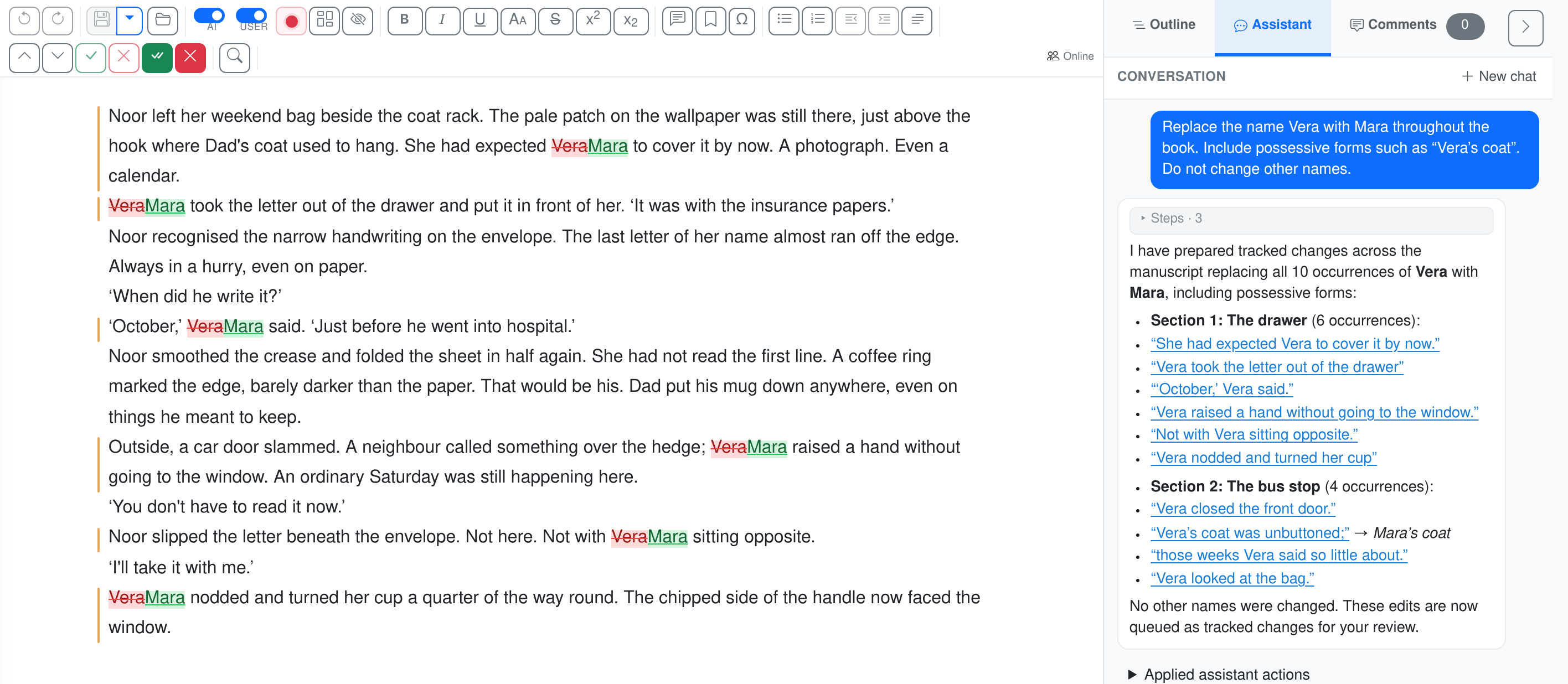
Real Word track changes
Every suggestion lands as a proper Word revision with an inline comment, so the author or editor can judge the change instead of pasting over the original and hoping the voice survived.
Your voice, kept on purpose
Voice preservation is a system-level constraint on every editing pass. You do not have to fight the prompt every time to stop the AI from rewriting you into its own house style.
Same paragraph. Two very different outputs.
Take a stiff scene of dialogue. Ask a chat tool to "make it more natural." Then run the same passage through EditBook.ai's floating AI-menu "Naturalize dialogue" action.
A single block of new text
Now you copy it back into Word. Track changes shows: "entire paragraph replaced." The diff is unreadable, the author cannot see what actually changed, and the voice is harder to defend.
The detailed comparison
Grouped by what tends to matter most. Pick the section that maps to your concern.
Long-form work, voice, and terminology
What separates a tool that can edit a 90,000-word novel from one that can rewrite a paragraph.
| EditBook.ai | ChatGPT / Claude (chat) | Copilot / Claude in Word | |
|---|---|---|---|
| Long manuscripts (100k+ words) |
Chapter-by-chapter pipeline with cross-chapter consistency passes
|
Hits context limits; you must copy-paste in chunks
|
Operates per-paragraph or per-selection; no cross-document memory
|
| Voice preservation as a constraint |
System-level instruction across every editing mode
|
Reverts to a generic AI register unless you re-prompt
|
Same — voice drifts under repeated suggestions
|
| Literary translation with terminology consistency |
Glossary extracted once, enforced across chapters; side-by-side editor with translator notes
|
Will translate any chunk you paste — terminology drift across chunks is your problem
|
Not a translation tool
|
Structured outputs the work can hang on
Editorial work runs on documents — reports, plans, track-changed files, feedback letters. Chat boxes produce text in a window you eventually lose.
| EditBook.ai | ChatGPT / Claude (chat) | Copilot / Claude in Word | |
|---|---|---|---|
| Structured analysis report |
Ten-axis review, audience fit, revision priorities — exportable PDF
|
Free-form prose answer; no persisted report
|
Not a feature
|
| Editing plan you approve first |
AI proposes a numbered plan, you edit it, then editing runs against your approved scope
|
You re-prompt for every change; nothing is enforced
|
You re-prompt for every paragraph
|
| Real Word track changes |
Every edit is a true Word revision with an explanatory inline comment
|
Plain-text suggestions; you reconstruct the diff by hand
|
Some suggestions land as comments; others overwrite text silently
|
| Bulk-review of recurring corrections |
Grouped patterns with accept-all / reject-all and per-occurrence drill-in
|
Repeats the same fix across paragraphs with no batch review
|
No grouped review surface
|
| Author-ready feedback report |
One-click export of a structured letter to the author
|
You write it yourself, summarising scattered chat outputs
|
Not a feature
|
House style, pricing, and your manuscript's privacy
The procurement-team questions: what does it cost, what does it do with your text, and can it pick up your house rules?
| EditBook.ai | ChatGPT / Claude (chat) | Copilot / Claude in Word | |
|---|---|---|---|
| House style guide enforcement |
Your publisher rules layered on top of language defaults — applied to every pass
|
Possible only if you re-paste the rules into every prompt
|
Not a feature
|
| Pricing model |
One-time per-project licence + pay-as-you-go AI credits
|
Monthly subscription whether you use it or not
|
Monthly Microsoft 365 add-on per seat
|
| Data — used to train models? |
Manuscripts contractually excluded from provider training; EU residency
|
Depends on plan tier; default consumer plans may train on your content
|
Depends on Microsoft/Anthropic settings at the tenant level
|
EditBook.ai vs. memoQ, Trados, and DeepL Pro
If you already work in a CAT tool, the question is not really "AI or no AI" — it is which tool fits the kind of translation you actually do. The pipeline differs more than the feature lists suggest; the table below makes both visible.
The naturalization pass is the part that is hardest to see from a feature list and matters most for literary work: an auditor re-reads the full translated draft, flags terminology drift and recurring source-language interference, and a second editing pass works that into the chapters — calibrated to the brief you set at the start. A CAT tool leaves this layer to the translator. A single-shot MT skips it.
| EditBook.ai | memoQ / Trados | DeepL Pro | |
|---|---|---|---|
| Primary use case |
Literary translation of a finished book — novel, memoir, non-fiction
|
Technical, legal, and commercial translation managed across agency workflows
|
Raw machine translation of any text, segment by segment
|
| Source analysis before translation |
Voice, register, period, narrator, and key terminology extracted from the source first
|
Not a feature — the translator brings that context themselves
|
Not a feature
|
| Strategy on a literal ↔ adaptation scale |
Five-point setting applied across the whole book; every revision honours it
|
Implicit in the translator's choices; no system-level setting
|
No equivalent — output style is fixed per language pair
|
| Cross-chapter terminology consistency |
Glossary extracted from the source once, enforced everywhere — including in your manual revisions
|
Strong: TermBase + segment-level enforcement is the CAT-tool sweet spot
|
Glossary feature exists but is shallow — term-by-term, no extraction
|
| Side-by-side editor with source ↔ target sync |
Free-flowing document view: source and target read like prose, kept in sync at the sentence level. Click a sentence in either pane and the other highlights.
|
Segment-by-segment grid — each source segment in a row next to its target. Robust for technical work; for literary prose the rigid alignment can fight against natural sentence-splitting.
|
Segmented two-pane editor in the Pro document tool. Comparable shape, less editorial control over the alignment.
|
| Translator comments on the text |
Inline sentence-level comments — visible next to the passage, exported to Word as proper Word comments.
|
Per-segment comments are standard. Display lives in a side panel rather than inline with the prose.
|
No collaborative comment layer in the document editor.
|
| Footnotes (literary translator essential) |
Footnotes attach to a sentence; the translator adds, edits, and renumbers them inline — preserved on export.
|
Awkward: footnotes are usually represented as inline tags or extracted as separate segments. Translators routinely work around this.
|
Footnote markers in the source are preserved on output, but there is no first-class footnote-authoring surface for the translator.
|
| Translation memory (TM) reuse from prior books |
Not yet — TMX import is on the roadmap.
|
Industry standard. Fuzzy matches across years of past work are the core CAT value prop
|
No TM — every translation is from scratch
|
| File formats |
.docx in, .docx out — with Word track changes on the translated draft
|
XLIFF, SDLXLIFF, .docx, many more — built for agency pipelines
|
.docx, .pdf, text — but output is finished, not a marked-up file you can review
|
| Pricing model |
One-time per-project licence (Studio tier) + pay-as-you-go AI credits
|
Perpetual licence (€700+ for individuals) plus annual maintenance
|
Monthly subscription per user, or per-character API pricing
|
| Best for… |
Literary translators producing publication-ready drafts of books, with voice and terminology that hold across the manuscript
|
Translators working at scale across many short projects, where TM and segment metadata pay off
|
Anyone wanting a fast machine-translation pass to post-edit themselves
|
Put another way: a CAT tool is most at home when you live in your translation memory. EditBook.ai is most at home when each book is read on its own terms and the voice has to hold from chapter one to chapter forty.
The objections we hear most
What we have heard from authors, editors, and translators we have spoken to — and what we tell them in reply.
"I already pay for ChatGPT Plus / Claude / Copilot. Why pay again?"
Those plans are flat-rate subscriptions you pay every month regardless of usage. EditBook.ai is a one-time licence per manuscript with credits you use only when you run a task. If you only do one or two manuscripts a year, that is dramatically cheaper. And the artefacts — analysis report, editing plan, track-changed Word file, side-by-side translation — are not artefacts you can get out of a chat box at all.
"Copilot is built into Word. Same thing, isn't it?"
Copilot edits the document you are looking at, paragraph by paragraph. It does not analyse the manuscript structurally, does not produce a full editorial report, does not enforce a house style guide, does not group recurring fixes, does not produce an author feedback letter, and does not translate with terminology consistency. It is a writing assistant; EditBook.ai is an editorial pipeline. They are different categories of tool.
"I am worried AI will flatten my voice."
So are we — and so is every author we have ever spoken to. EditBook.ai treats voice preservation as a hard constraint, written into every editing pass at the system level. The system is also explicitly told to prefer consistency with the rest of your manuscript over locally-optimal phrasing, and every change shows up as a track-change you can reject. The result reads like a better version of you, not like a different writer.
"My manuscript is sensitive. What about confidentiality?"
Manuscripts are encrypted at rest and in transit. AI providers are contractually bound to exclude your content from model training. Data is held in EU data centres. You can delete a manuscript at any time and it is gone — including from backups, within our defined retention window.
What happens to your manuscript
Encrypted, not training data
Encrypted in transit and at rest. AI providers contractually excluded from training on your manuscript. EU data residency available via EU-only mode.
GDPR-compliant, DPF-routed
Primary storage in the EEA. International AI transfers covered by the EU-US Data Privacy Framework and SCCs. Standard DPA available on request.
Yours to delete
Delete a manuscript at any time and it is gone — including from backups, within our defined retention window. Your data, your call.
See for yourself on a real manuscript
Start with a single project licence — no subscription, no per-seat cost. You only pay for the AI tasks you actually run.